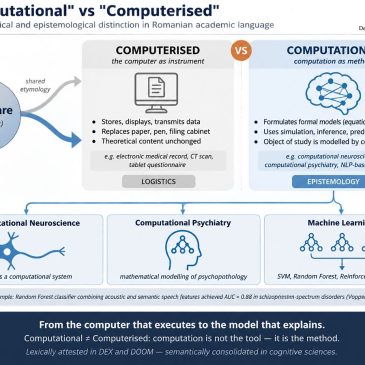
Conceptual and Lexical Delimitations in Cognitive Sciences. The Neologism “Computational” in Romanian Academic Terminology

This article analyses the lexical, semantic and epistemological status of the adjective “computational” in Romanian academic language, starting from the observation that the term is frequently confused with the native adjective “computerizat” (computerised). The main objective is to demonstrate that the two terms are not synonyms and that “computational” fulfils a distinct terminological function, indispensable in the frontier domains of cognitive sciences. A secondary objective concerns the psycho-sociological and anthropological analysis of how this neologism reconfigures everyday vocabulary and social representations of technology.
MultiMedia Publishing Modernizes the Infrastructure of Its Journal IT & C and Introduces a Fully Online Editorial Workflow

posted in: Media 0

IT & C is gradually moving to an OJS-based editorial infrastructure, extended academic metadata, DOI identifiers, and standardized digital processes MultiMedia Publishing announces an important stage in the development of the academic journal it manages — IT & C — … Read More

Digital Architectures for Judicial Psychological Evidence: A Translational Analysis of the Integration of Virtual Reality, Artificial Intelligence and Blockchain in the Assessment of Minors

To provide a translational analysis of emerging technologies—Virtual Reality (VR), Artificial Intelligence (AI), and Blockchain—in the judicial psychological assessment of minors, examining both their potential to enhance evidence validity and the risks they pose to memory integrity, procedural fairness, and fundamental rights.

Artificial Intelligence, Biometrics and Immersive Technologies in Juvenile Forensic Assessment: A Translational Analysis of Neuropsychological, Evidentiary and Ethical Implications

The integration of Artificial Intelligence (AI), biometrics and Virtual Reality (VR) into judicial assessment represents a major transformation of evidentiary procedures. In cases involving minors, these technologies raise distinct neuropsychological and ethical challenges that require urgent translational analysis.

Advanced Persistent Threats in Contemporary Cybersecurity – An Analytical Overview

Advanced Persistent Threats (APTs) have become one of the defining security challenges of the digital era because they combine strategic intent, operational patience, and technical adaptability. Unlike high-volume cybercrime, APT operations are often intelligence-led campaigns that prioritize long-term access, data collection, and prepositioning for potential disruption. This essay examines APTs from conceptual, operational, and governance perspectives. It first clarifies the APT construct and explains why persistence and adaptability matter more than malware novelty alone. It then analyzes current attacker tradecraft (e.g., supply-chain compromise, living-off-the-land, cloud abuse, and vulnerability exploitation), using public evidence from recent government advisories and industry incident datasets. The essay next evaluates defensive responses, including threat-informed defense with MITRE ATT&CK, zero trust architecture, modern incident response doctrine, and supply-chain risk controls. Finally, it discusses the policy shift toward mandatory reporting and board-level cyber governance across the U.S. and Europe. The central argument is that APT resilience is less a product of any single tool and more a function of integrated architecture, disciplined operations, and institutional accountability.

Articles published according to the current editorial policy