

Psih. Eusebiu Jean TIHAN[1], MSc, Psih. Laura Mihaela TIHAN[2], MSc
eusebiu.tihan@gmail.com
[1] Academy of Sciences of Romania, https://orcid.org/0009-0008-8316-3679
[2] Tihan and Associates, https://orcid.org/0009-0003-1820-1417
Abstract
Objectives: This article analyses the lexical, semantic and epistemological status of the adjective “computational” in Romanian academic language, starting from the observation that the term is frequently confused with the native adjective “computerizat” (computerised). The main objective is to demonstrate that the two terms are not synonyms and that “computational” fulfils a distinct terminological function, indispensable in the frontier domains of cognitive sciences. A secondary objective concerns the psycho-sociological and anthropological analysis of how this neologism reconfigures everyday vocabulary and social representations of technology.
Methods: The research is qualitative, based on the analysis of open-source documents (normative dictionaries, specialised scientific literature, published empirical studies) and on the content analysis of terminological phrases. Romanian lexicographic sources (DEX, DOOM, MDN) and international literature in computational neuroscience and computational psychiatry were consulted. The analysis was complemented by a psycho-sociological perspective on the circulation of the term in public and academic discourse.
Results: The analysis demonstrates that “computational” is already lexicographically attested in Romanian, with the definition “referring to computation, proceeding by computation”. The distinction from “computerised” is systematic: the former indicates computation as a constitutive principle of theory, the latter indicates the computer as an instrument. In computational psychiatry, algorithms such as Support Vector Machines, Random Forest and Reinforcement Learning transform complex clinical phenomena into mathematical variables that can participate in classification and prediction. The empirical studies cited (Voppel et al., 2023; Kizilay et al., 2024) confirm the value of computational approaches in predicting transition to psychosis. From a psycho-sociological perspective, the term “computational” functions as a marker of a new epistemic authority, reorganising symbolic hierarchies between “instrument” and “method”.
Conclusions: “Computational” is not a non-existent or improvised term in Romanian, but a specialised neologism already attested, undergoing semantic consolidation in new interdisciplinary fields. Its use is justified when it designates computation as a method of modelling and knowledge, not the mere use of a computer. From an anthropological perspective, the term signals a profound change in the way contemporary society represents the relationship between thought and computation.
Public Use Statement: This article may be used for academic and educational purposes, provided the author and the journal are properly cited. The content may be freely distributed in the academic environment, without commercial restrictions.
Keywords: computational, computerised, academic terminology, computational neuroscience, computational psychiatry, machine learning, mathematical modelling, psychological anthropology.
Delimitări conceptuale și lexicale în științele cognitive. Neologismul ”computațional” în terminologia academică românească
Rezumat
Obiective: Prezentul articol analizează statutul lexical, semantic şi epistemologic al adjectivului „computaţional” în limba română academică, pornind de la observaţia că termenul este frecvent confundat cu adjectivul autohton „computerizat”. Obiectivul principal este de a demonstra că cei doi termeni nu sunt sinonimi şi că termenul „computaţional” îndeplineşte o funcţie terminologică distinctă, indispensabilă în domeniile de frontieră ale ştiinţelor cognitive. Un obiectiv secundar vizează analiza psihosociologică şi antropologică a modului în care acest neologism reconfigurează vocabularul cotidian şi reprezentările sociale ale tehnologiei.
Metode: Cercetarea este de tip calitativ, bazată pe analiza de documente din surse deschise (dicţionare normative, literatură ştiinţifică de specialitate, studii empirice publicate) şi pe analiza de conţinut a sintagmelor terminologice. Au fost consultate surse lexicografice româneşti (DEX, DOOM, MDN) şi literatură internaţională din domeniul neuroştiinţelor computaţionale şi psihiatriei computaţionale. Analiza a fost completată de o perspectivă psihosociologică asupra modului în care termenul circulă în discursul public şi academic.
Rezultate: Analiza demonstrează că „computaţional” este deja atestat lexicografic în limba română, cu definiţia „referitor la computaţie, care procedează prin computaţie”. Distincţia faţă de „computerizat” este sistematică: primul indică calculul ca principiu constitutiv al teoriei, al doilea indică calculatorul ca instrument. În psihiatria computaţională, algoritmi precum Support Vector Machines, Random Forest şi Reinforcement Learning transformă fenomene clinice complexe în variabile matematice care pot participa la clasificare şi predicţie. Studiile empirice citate (Voppel et al., 2023; Kizilay et al., 2024) confirmă valoarea abordărilor computaţionale în predicţia tranziţiei către psihoză. Din perspectivă psihosociologică, termenul „computaţional” funcţionează ca un marker al unei noi autorităţi epistemice, reorganizând ierarhiile simbolice dintre „instrument” şi „metodă”.
Concluzii: „Computaţional” nu este un termen inexistent sau improvizat în română, ci un neologism specializat deja atestat, aflat în proces de consolidare semantică în noile domenii interdisciplinare. Utilizarea sa este justificată atunci când desemnează calculul ca metodă de modelare şi cunoaştere, nu simpla utilizare a calculatorului. Din perspectivă antropologică, termenul semnalează o schimbare profundă în modul în care societatea contemporană îşi reprezintă relaţia dintre gândire şi calcul.
Declaraţie de utilizare publică: Acest articol poate fi utilizat în scopuri academice şi educaţionale, cu condiţia citării corespunzătoare a autorului şi a revistei. Conţinutul poate fi distribuit liber în mediul academic, fără restricţii comerciale.
Cuvinte-cheie: computaţional; computerizat; terminologie academică; neuroştiinţe computaţionale; psihiatrie computaţională; învăţare automată; modelare matematică; antropologie psihologică.
IT & C, Volumul 5, Numărul 4, Decembrie 2026, pp. xxx
ISSN 2821 – 8469, ISSN – L 2821 – 8469, DOI: 10.58679/IT16258
URL: https://www.internetmobile.ro/en/conceptual-and-lexical-delimitations-in-cognitive-sciences-the-neologism-computational/
© 2026 Eusebiu Jean TIHAN, Laura Mihaela TIHAN. Responsabilitatea conținutului, interpretărilor și opiniilor exprimate revine exclusiv autorilor.
CC BY 4.0 License
1. INTRODUCTION
1.1. A seemingly lexical question, a profoundly anthropological problem
There are questions that appear, at first glance, to be simple matters of vocabulary. We hear them in academic conversations, in seminar rooms, in public debates, and we often treat them as technical details, worthy of interest only for linguists or text editors. Yet some of these questions conceal, beneath their modest surface, profound tensions concerning the way a society represents reality, organises knowledge, and constructs its symbolic hierarchies.
The question “is it correct to say computational or should we say computerised?” belongs to this category. It is not merely a dispute about an adjective. It is a window onto a much broader cultural transformation: the passage from an era in which the computer was perceived as an external tool, a mechanical extension of the human hand and mind, to an era in which computation becomes a paradigm of knowledge, a way of understanding the world, of modelling it, of simulating it, and of predicting it.
A Romanian psychologist, Eusebiu Tihan, formulated this question in a manner that deserves to be taken seriously. Observing the frequency of the phrases “computational neuroscience” and “computational psychiatry” in academic discourse, he raised a legitimate problem: in Romanian, he said, “computational” does not exist; would the correct term not perhaps be “computerised”, that is, computer-assisted?[3]
This observation is not naïve. It expresses a natural linguistic intuition, shared by many cultivated speakers of Romanian. It also reflects a certain cognitive and emotional configuration: when we hear a new word, especially one that sounds foreign, our instinct is to seek the familiar equivalent, to reduce the unknown to the known, to translate. And the most readily available translation seems to be “computerised”, because we know what a computer is, we know what it means to be “computerised”, and it is difficult for us to accept that a term so close in sound could designate something fundamentally different.
But precisely this phonetic proximity is deceptive. It conceals a conceptual distinction that contemporary sciences consider essential. And this distinction is not a gratuitous theoretical refinement. It has practical, methodological, and ultimately existential consequences. It changes the way we understand what we are doing when we research, when we diagnose, when we treat, when we teach, when we think.
1.2. Why this question matters for an IT&C journal
A journal dedicated to information and communication technology might seem an unusual place for a discussion about terminology. What connection does an adjective have with technology? What relevance does a semantic distinction have for readers interested in software, networks, or artificial intelligence?
The answer is that precisely in the field of IT&C the distinction between “computerised” and “computational” becomes not merely relevant, but central. For IT&C has long ceased to be merely the domain of computers. It is the domain in which computation becomes a method of knowledge. It is the space where computer science, mathematics, statistics, psychology, neuroscience, medicine, economics, and linguistics meet. And this encounter produces not only new technologies, but also new vocabulary, new concepts, new ways of thinking.
When a machine learning algorithm predicts the probability that a young person at clinical risk will develop psychosis in the next 24 months, we are not talking about a computer assisting a physician. We are talking about a mathematical model that transforms symptoms, psychometric scores, language characteristics, and neuroimaging data into calculable variables, integrates them into a probabilistic space, and produces an estimate that no human eye could achieve. This is a computational act. And the term that designates it is not a linguistic ornament. It is a condition of intelligibility.
1.3. Structure of the article
This article is structured as follows. In section two, we analyse the lexical status of the term “computational” in Romanian dictionaries, showing that it is already attested and standardised. In section three, we propose a semantic analysis of the distinction between “computerised” and “computational”, insisting that the difference is not merely technical, but epistemological. In section four, we examine the applications of this distinction in computational neuroscience and computational psychiatry, discussing algorithms such as SVM, Random Forest, and Reinforcement Learning. In section five, we analyse the psycho-sociological and anthropological implications of adopting the term, showing how it reconfigures everyday vocabulary and social representations of technology. In section six, we propose an operational definition and a differentiated usage strategy. Finally, we formulate the conclusions and the academic contribution of the paper.
1.4. Novelty Statement
This paper introduces a systematic terminological distinction between “computational” and “computerised” in the Romanian academic context, offering an original operational definition and a differentiated usage strategy according to the target audience. The novelty consists in integrating lexicographic analysis with empirical examples from computational neuroscience and computational psychiatry, and with a psycho-sociological perspective on how the term reconfigures social representations of technology. The paper demonstrates that “computational” is not a simple Anglicism, but a marker of an epistemological transition from the computer as an instrument to computation as a method of knowledge. It also proposes a series of Romanian descriptive alternatives that allow authors to avoid the neologism without losing conceptual precision.
2. LEXICAL STATUS: WHAT DICTIONARIES SAY AND WHY IT MATTERS
2.1. A discreet but real presence
When someone states that “in Romanian there is no computational“, they are stating something that sounds plausible. It is true that the term does not belong to the fundamental vocabulary of the language, that we do not encounter it in everyday conversations, that it does not appear in school textbooks, that it is not used by our grandparents. It is a word belonging to a specialised, technical, academic register. And precisely because we do not encounter it in everyday life, we have the impression that it does not exist.
But this impression is misleading. The term exists, is attested, is standardised. DEX defines “computational” as “referring to computation, proceeding by computation” (DEX, 1998, s.v. computațional). DOOM fixes the correct form: computațional adj. m., pl. computaționali; f. sg. computațională, pl. computaționale (DOOM, 2005, s.v. computațional). The major dictionaries of neologisms indicate the etymology from the English computational (MDN, 2000, s.v. computațional).
Moreover, phrases such as “computational geometry” and “computational graphics” have been established in Romanian technical literature for several decades. DEX defines computational geometry as “an interdisciplinary field comprising computer representation, input, output, and analysis of geometric data” (DEX, 1998, s.v. geometrie computațională), and computational graphics as “a set of methods and techniques for converting numerical information into graphic images with the aid of a computer” (DEX, 1998, s.v. grafică computațională).
Therefore, the term is not a recent invention of the discourse on artificial intelligence. It is a word that entered Romanian with the development of theoretical computer science and applied mathematics in the second half of the twentieth century, and which has gradually consolidated in specialised vocabulary.
2.2. Why lexicographic attestation is not sufficient
The fact that a term is attested in dictionaries does not automatically mean that its use is justified in any context. Dictionaries record words, but do not decide their fate. A word may be attested and yet useless; another may be absent from dictionaries and yet essential. The fundamental criterion for scientific terminology is not presence in the dictionary, but the capacity of the term to delimit a concept.
This is the problem raised by the observation of psychologist Eusebiu Tihan. His question is not “does computational exist in the dictionary?”, but “why should we use computational when we already have computerised?”. It is a question about the function of the term, not about its existence.
And the answer to this question cannot be found in dictionaries. It must be sought in conceptual analysis, in the epistemology of scientific practices, in the way academic communities construct and transmit knowledge.
3. SEMANTIC ANALYSIS: TWO WORDS, TWO CONCEPTUAL WORLDS
3.1. A deceptive resemblance
The confusion between “computational” and “computerised” arises from a surface resemblance: both refer to the idea of “computer”. They sound almost alike. They share the same etymological root. They appear to describe the same thing: the relationship between a process and a computer.
But beneath this resemblance lies a fundamental distinction. A distinction that is not merely technical, but conceptual. A distinction that changes the way we understand what we are doing when we research.
3.2. “Computerised” — the level of the instrument
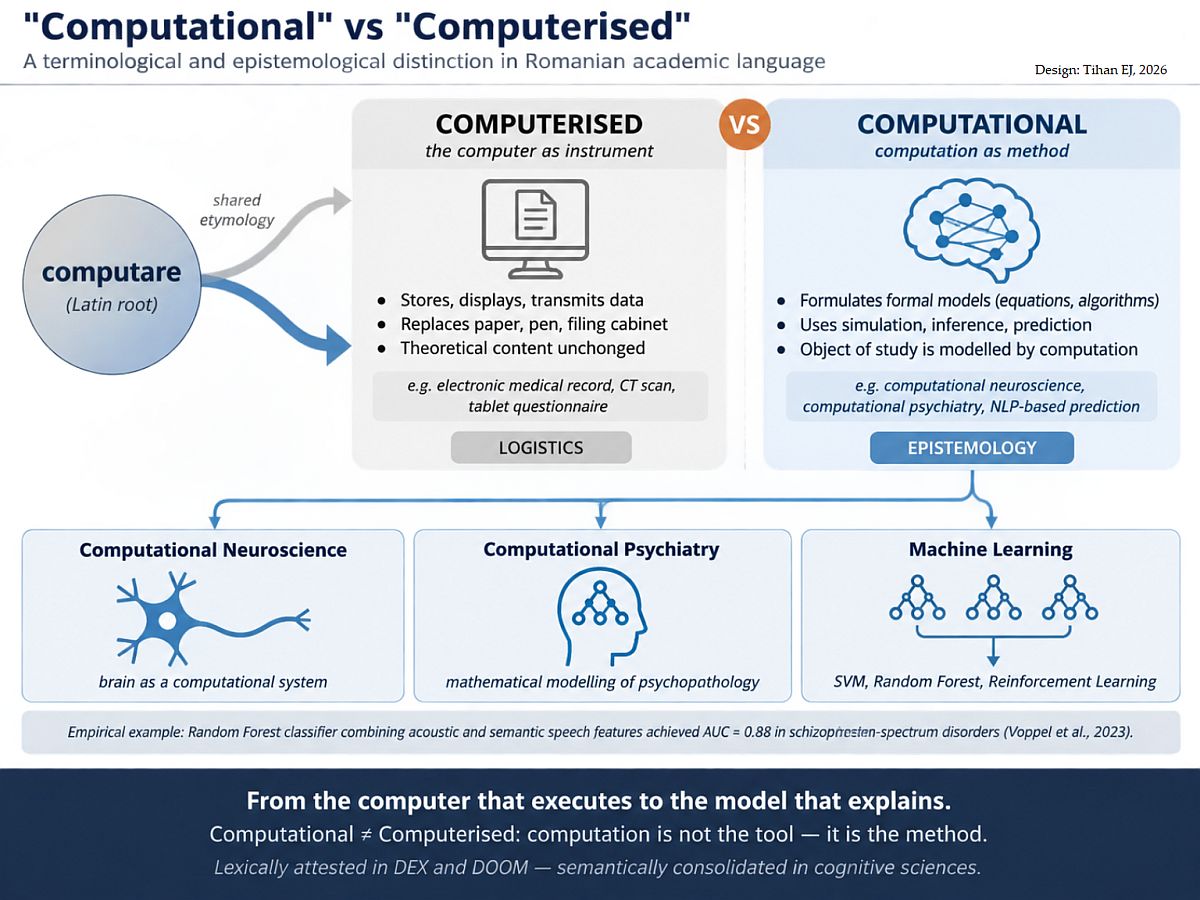
“Computerised” describes a relationship of an instrumental type. A process, an activity, or a system is computerised when it uses the computer as a tool. DEX defines the term as that which is “under the control of the computer” (DEX, 1998, s.v. computerizat). Examples are numerous and familiar: the electronic medical record is computerised; computerised tomography (CT) uses the computer to reconstruct images; administering a questionnaire on a tablet instead of paper is a computerisation of test administration.
In all these cases, the computer stores, transmits, displays, or assists operations. The theoretical content of the activity remains unchanged if we replace the computer with a pencil and a sheet of paper — only speed and volume are modified. A physician completing a medical record on paper and a physician completing it on a computer are, from a conceptual point of view, doing the same thing. Only the instrument differs.
This observation is important because it shows that “computerised” does not describe a paradigm shift. It describes an infrastructural shift. It is a technical, administrative, organisational notion. It belongs to the sphere of logistics, not to the sphere of epistemology.
3.3. “Computational” — the level of the method
“Computational” describes a constitutive relationship. The object of study itself is understood, modelled, or explained as a process of computation. The emphasis falls not on “using the computer”, but on “thinking in terms of computation”.
When we say that a domain is “computational”, we affirm that:
- its theoretical objects are formulated as formal models (equations, algorithms, probabilistic structures);
- its explanatory logic is based on computational simulation or inference;
- its methodological boundaries are given by computability, not by the presence of a physical device.
Thus, “computational neuroscience” does not mean “researching the brain with the aid of a computer”, but “understanding the brain as a computational system and describing its functioning through mathematical models”. Likewise, “computational psychiatry” is not “computer-assisted psychiatry”, but “mathematical modelling of psychopathological processes” through instruments such as reinforcement learning, Bayesian inference, or dynamical systems theory.
This distinction is not a theoretical subtlety. It has practical consequences. It changes the way we formulate research questions, the way we construct models, the way we interpret results.
3.4. An operational criterion of discrimination
To decide in which situation we find ourselves, we can use the following criterion: if, by replacing the computer with an analogue instrument (paper, pencil, pocket calculator), the theoretical thesis of the study remains intact, then the study is “computerised”. If, on the contrary, the elimination of the computational model makes the research question no longer formulable, then the study is “computational”.
This simple criterion can be applied by any author who hesitates in choosing the term. It is not perfect — there are borderline situations, hybrid situations, situations in which both dimensions are present — but it is useful for academic writing.
3.5. A distinction with roots in epistemology
The distinction between “computerised” and “computational” is not an invention of Romanian linguists. It reflects a fundamental distinction in the philosophy of science: the distinction between instrument and method, between means and principle, between technique and theory.
In the epistemological tradition, the instrument is that which extends the natural powers of the researcher: the microscope extends sight, the telescope extends sight, the computer extends the capacity for calculation. The method, by contrast, is that which structures the very possibility of knowledge: it determines what questions can be asked, what answers can be accepted, what criteria of validity apply.
“Computerised” belongs to the sphere of the instrument. “Computational” belongs to the sphere of the method. This is the fundamental distinction. And its consequences are far from being merely linguistic.
4. APPLICATIONS IN COMPUTATIONAL NEUROSCIENCE AND COMPUTATIONAL PSYCHIATRY
4.1. Computational neuroscience: when the brain becomes an object of modelling
In traditional neuroscience, the computer can be used for collecting, storing, and visualising data. An MRI scanner produces digital images; a computer stores, displays, and processes them. This is a computerised activity.
In computational neuroscience, computation participates in the construction of the explanatory model. Neuronal activity can be described through dynamical systems, differential equations, probabilistic models, artificial neural networks, or algorithms that attempt to capture certain properties of information processing (Abbott, 2008; Dayan & Abbott, 2001).
The difference is fundamental. An MRI image can be stored on a computer. But the computational analysis of that image may involve extracting features, reducing dimensionality, classifying anatomical patterns, or estimating the probability that a certain profile belongs to a clinical category (Koutsouleris et al., 2009).
In the first case, the computer is the support. In the second, computation is the epistemic instrument. This distinction explains why the phrase computational neuroscience is semantically justified. It does not describe a laboratory full of computers. It describes a theoretical approach in which the brain is conceived as a computational system and studied through formal models.
4.2. Computational psychiatry: from description to modelling
Psychiatry is one of the domains in which the terminological difference becomes particularly important. Traditional psychiatric diagnosis relies to a large extent on clinical observation, interview, operationalised criteria, and behavioural assessment. Computational psychiatry introduces an additional level: the mathematical formalisation of data and of the mechanisms that may underlie behaviour and symptomatology (Huys, Maia & Frank, 2016; Adams, Huys & Roiser, 2016).
Huys et al. (2016) describe two major directions: data-driven approaches, which use machine learning for classification and prediction, and theory-driven approaches, which attempt to represent mechanisms through explicit models. This distinction is relevant also for the lexical problem discussed here.
A system that merely records diagnoses in a database is computerised. A system that uses clinical data to construct a predictive model of patient evolution is computational. The first situation pertains to logistics. The second pertains to epistemology.
4.3. Support Vector Machines: classification and prediction
Support Vector Machine (SVM) is a supervised learning algorithm used for classifying observations in multidimensional spaces. In psychiatric research, this method can be applied to datasets combining clinical, psychometric, imaging, or biological indicators.
Such a model does not “computerise” diagnosis in the simple sense of the term. It constructs a mathematical representation of the differences between classes. Research on at-risk states for psychosis has already demonstrated the utility of multivariate classification of neuroanatomical patterns. A study by Koutsouleris and collaborators (2009) used the classification of neuroanatomical patterns obtained through structural MRI to identify individuals in at-risk states and to predict transition to psychosis.
Importantly, this approach is not reducible to “using the computer for MRI analysis”. It involves learning a classification model from the structure of the data. And this learning is a computational process, not a computerised one.
4.4. Reinforcement Learning: modelling decision
Another relevant family is represented by Reinforcement Learning models. These models attempt to formalise the way in which an agent learns from the consequences of its actions (Maia & Frank, 2011).
In a simplified formulation, the reward prediction error can be represented through relations of the form:
δt=rt+γV(st+1)−V(st)
where rt represents the reward obtained, V(st) the estimated value of a state, and γ the discount factor (Maia & Frank, 2011).
In cognitive sciences, such models can be used to estimate parameters describing learning and decision processes. Here the semantic difference becomes evident. It is not “computerised” that the model runs on a computer. It is “computational” because a cognitive process is represented through an executable mathematical formalism.
4.5. Random Forest and prediction in psychopathology
One of the most intuitive demonstrations of the utility of the term “computational” is offered by Random Forest models. A Random Forest is an ensemble of decision trees constructed on samples and subsets of features, whose results are aggregated to obtain a prediction (Iniesta, Stahl & McGuffin, 2016).
In a clinical context, features may come from different sources: psychometric scores, language characteristics, behavioural variables, or neuroimaging data. Importantly, the algorithm does not apply a simple clinical rule of the type if X, then Y. It estimates a probabilistic relationship between a large number of variables.
This is one of the situations in which the term computational describes the methodology better than “computerised”. It does not say that a computer was used. It says that a mathematical model was constructed that learns from data and produces probabilistic predictions.
4.6. Relevant empirical studies
Here a methodological delimitation is necessary. In an earlier version of the argument, the value AUC > 0.85 was advanced for a multimodal architecture combining semantic coherence of language with cortical thickness. Such a claim is too specific to be presented without exact identification of the study that produced it.[4]
Verifiable literature, however, offers results very close in relevance to our demonstration.
A study published in Schizophrenia Bulletin by Voppel and collaborators (2023) analysed acoustic and semantic characteristics of speech in persons with schizophrenia-spectrum disorders and healthy controls. Random Forest classifiers were trained separately for the acoustic and semantic domains, as well as a combined model. The semantic model obtained an AUC of 0.83, the acoustic model 0.82, and the combined model reached AUC = 0.88, with 10-fold cross-validation (Voppel et al., 2023).
The result is particularly relevant for the thesis of the present article: the fusion of different sources of information can increase classifier performance. Moreover, the study shows that the variability of semantic similarity was one of the important features of the combined classifier.
A study published in Schizophrenia Research in 2024 automatically analysed the linguistic characteristics of young people at clinical high risk for psychosis. The machine learning model constructed from 30 NLP-derived features obtained an average accuracy of 79.6% and an AUC-ROC of 0.86 (Kizilay et al., 2024).
These results do not demonstrate that any combination of NLP and neuroimaging will automatically achieve AUC > 0.85. They demonstrate, however, something more important for our theme: computational methods allow the transformation of complex clinical phenomena — including language — into mathematical variables that can participate in classification and prediction.
5. PSYCHO-SOCIOLOGICAL AND ANTHROPOLOGICAL IMPLICATIONS
5.1. The term as a marker of a new epistemic authority
Beyond technical and methodological aspects, the adoption of the term “computational” has profound implications at the level of social representations and the psycho-social dynamics of the academic community.
A term is not merely a label. It is a marker of position. When a researcher uses the phrase “computational psychiatry” instead of “computerised psychiatry”, he or she does not merely describe a practice. He or she positions himself or herself within a certain epistemic field. He or she signals belonging to a community that thinks in terms of formal models, algorithms, probabilistic inference. He or she claims a certain epistemic authority.
This psycho-sociological dimension is important because it explains why the term is sometimes felt as intimidating, elitist, or useless. It is not merely an instrument of communication. It is an instrument of social delimitation. It marks a boundary between those who “know” and those who “do not know”, between those who belong to the new paradigm and those who remain in the old paradigm.
5.2. Reconfiguration of everyday vocabulary
An essential aspect, but often overlooked, is the way in which terms such as “computational” migrate from academic discourse towards everyday vocabulary. This migration is not neutral. It changes the way ordinary people represent technology, intelligence, mind, decision.
When a patient hears that his or her diagnosis was established through a “computational model”, he or she does not necessarily understand what this means. But he or she perceives something: that the process leading to the diagnosis is more complex, more abstract, less accessible than a simple clinical examination. He or she perceives that there is a zone of technical opacity between himself or herself and the decision that concerns him or her.
This perception has real psychological consequences. It can generate trust (“modern science is more precise”) or suspicion (“I am reduced to an algorithm”). It can generate the feeling of being well cared for or, on the contrary, the feeling of being dehumanised. The term “computational” is, therefore, not merely a matter for specialists. It is a matter that touches the intimacy of the relationship between human and technology.
5.3. An anthropology of computation
From an anthropological perspective, the transition from “computerised” to “computational” can be read as an indication of a deeper transformation in the way contemporary society represents the relationship between thought and computation.
In classical anthropology, the distinction between techne and episteme — between craft and theoretical knowledge — was fundamental for understanding ways of doing and thinking. “Computerised” belongs to the sphere of techne: it is a craft, a technique, an ability to use an instrument. “Computational” belongs to the sphere of episteme: it is a form of theoretical knowledge, a way of understanding the world through formalisation.
This transition from techne to episteme is not a simple change of vocabulary. It signals a change in the way contemporary society conceives its relationship with reality. Reality is no longer merely observed, described, classified. It is modelled, simulated, calculated. And this modelling is not a simple technical operation. It is a form of knowledge.
5.4. Resistance to neologism as a psycho-social phenomenon
Resistance to the term “computational” — expressed through the legitimate question “why don’t we say computerised?” — can also be understood as a psycho-social phenomenon of defending linguistic identity.
In social psychology, resistance to innovation is often correlated with the need for control, predictability, and continuity. A new term, especially one that sounds foreign, can be felt as a threat to the familiar order of language. It introduces a distinction that was not necessary before, a complication that seems gratuitous, a barrier that seems useless.
This resistance is not irrational. It expresses a legitimate need to preserve the intelligibility and accessibility of academic language. It also expresses a certain suspicion towards linguistic imports that seem to serve prestige more than communication.
But precisely for this reason it is important to distinguish between legitimate resistance to gratuitous jargon and resistance to a term that designates a real conceptual distinction. “Computational” belongs to the second category. It does not complicate language for the sake of complication. It complicates language in order to make visible a distinction that would otherwise remain invisible.
6. OPERATIONAL DEFINITION AND USAGE STRATEGY
6.1. An operational definition
On the basis of the delimitations above, for Romanian IT&C and interdisciplinary terminology the following operational definition may be proposed:
Computational, -ă — adjective designating that which uses computation, algorithms, mathematical formalisation, simulation, or algorithmic modelling as components of the method of representing, analysing, explaining, or predicting a phenomenon.
This formulation is broader than the simple association of the term with “the computer”, but more precise than using it as a generic synonym for “digital”. It allows the delimitation of three concepts:
- digital → information is represented in a digital form;
- computerised → a process is carried out or assisted by means of a computer;
- computational → computation and algorithmic formalisation are part of the method by which the phenomenon is analysed, represented, or modelled.
6.2. Differentiated usage strategy
Recognition of the academic necessity of the term “computational” does not imply using it in any context. I propose a differentiated strategy, on three levels:
Level 1 — general public or political discourse. Explanatory formulas may be used: “neuroscience based on mathematical modelling”, “psychiatry with algorithmic models”. Conciseness is lost, but accessibility is gained.
Level 2 — interdisciplinary academic public, but non-computational. Transitional phrases may be adopted, such as “computational modelling” or “algorithmic approach”, with a definition at first occurrence.
Level 3 — specialists in cognitive, computational, or advanced clinical sciences. The term “computational” must be used directly, because it possesses terminological precision and international commensurability. Avoiding it would fragment the terminological system and hinder communication with specialised literature.
6.3. Romanian descriptive alternatives
Table 1.
| Specialised term | Descriptive alternative |
| computational neuroscience | theoretical neuroscience and mathematical modelling |
| computational psychiatry | mathematical and predictive modelling in psychiatry |
| computational model | mathematical/algorithmic model |
| computational approach | approach based on computation and modelling |
| computational analysis | algorithmic and statistical analysis |
However, the equivalences are not perfect. For example, “mathematical modelling” does not always cover the entire sphere of computational modelling, because a computational model may include algorithmic procedures, simulations, symbolic representations, or machine learning techniques that are not reducible to a traditional mathematical formulation. Therefore, the Romanian alternative must be chosen contextually, not imposed as a universal substitute.
7. CONCLUSIONS
The present analysis started from a seemingly simple lexical problem: whether in Romanian one should use “computerised” or “computational”. Lexicographic documentation shows that the formulation “computational does not exist in Romanian” can no longer be sustained. The term is already attested in Romanian lexicographic sources and is present in the terminology of domains such as computational linguistics.
The interesting problem is, therefore, another: what specialised meaning does the term acquire in the new interdisciplinary sciences? The proposed answer is that “computational” must not be confused with “computerised”. “Computerised” places emphasis on the use of the computer as an instrument or technical infrastructure. “Computational” places emphasis on computation, formalisation, algorithm, modelling, simulation, or inference as part of the scientific method.
This difference becomes evident in computational neuroscience and computational psychiatry, where behavioural, linguistic, neurobiological, and imaging data can be transformed into mathematical features and integrated into predictive models. Empirical literature already confirms the value of such approaches. In the study by Voppel et al. (2023), the combination of acoustic and semantic features through a Random Forest classifier led to an AUC of 0.88, superior to the performance of models based on each domain separately. Another recent study on young people at clinical risk for psychosis obtained an AUC-ROC of 0.86 using features derived from automated language analysis (Kizilay et al., 2024).
These results do not justify impermissible extrapolations. In particular, an AUC value must not be transferred from one experimental architecture to another without direct empirical demonstration. This precaution does not weaken the argument concerning the term “computational”. On the contrary, it strengthens it. A mature scientific language does not need spectacular words, but precise conceptual delimitations.
Consequently, for Romanian academic terminology, “computational” may be characterised as a specialised neologism, already attested, undergoing semantic consolidation in the interdisciplinary domains generated by the development of computation, artificial intelligence, and cognitive sciences.
It is not necessary to choose between Romanian and international terminology. The more productive solution is to understand exactly what the term designates and to use it only when the concept it expresses is genuinely necessary. In essence, this is the function of a scientific terminology: not to multiply words uselessly, but to differentiate concepts that have become sufficiently different to need different names.
7.1. Academic Contribution
This study contributes to the literature on Romanian scientific terminology by demonstrating that “computational” and “computerised” are not synonyms, but designate distinct conceptual levels: instrument versus method. This distinction extends the theoretical framework of terminological analysis towards the emerging domains of cognitive sciences and offers an original operational definition for Romanian academic use. The paper also offers a psycho-sociological and anthropological perspective on how the term reconfigures social representations of technology, contributing to a more nuanced understanding of terminological acceptance processes in non-Anglophone contexts.
7.2. Limitations and Cautions
- Limitations of the computational approach: a model can predict without explaining; an algorithm can classify without offering causality.
- Methodological problems: small samples, unbalanced data, confounders, lack of external validation, overfitting, differences between training and clinical populations, interpretability problems (Iniesta, Stahl & McGuffin, 2016).
- Terminological precautions: “computational” must not become synonymous with “more exact” or “more scientific”.
- Limitations of the present study: the analysis is qualitative and conceptual; no empirical study with human participants was conducted; generalisation of conclusions to other linguistic contexts requires caution.
7.3. Recommendations for Future Research
- Development of empirical studies comparing the performance of computational models in different clinical populations;
- Investigation of multimodal data integration (NLP, neuroimaging, genetics);
- Exploration of Romanian linguistic alternatives for the term “computational”;
- Analysis of Romanian specialists’ perception of computational terminology;
- Study of how the term “computational” is used in Romanian IT&C publications;
- Psycho-sociological research on resistance to neologisms in Romanian academic discourse.
Acknowledgments
The author thanks colleagues in the field of psychiatry and neuroscience for discussions that contributed to the clarification of certain terminological aspects. He also thanks the IT&C journal for the opportunity to publish this article.
Declarations
Author Contributions
Psych. Eusebiu Tihan conceptualised the study, developed the methodology, conducted the formal analysis, investigated lexicographic and scientific sources, and critically reviewed the manuscript. The author approved the final version of the manuscript. Psych. Laura Tihan prepared the original draft, contributed to the collection and selection of documents from open sources, processed term extraction, and collaborated on semantic analysis and content analysis.
Funding
This research received no external funding.
Conflict of Interest
The author declares that there are no conflicts of interest relevant to this article.
Generative Artificial Intelligence Use Statement
In the editorial preparation stage of the manuscript, a generative artificial intelligence tool was used to support the structuring, documentation, and redrafting of the text. The human author remains responsible for the final content, the accuracy of statements, the verification of sources, the interpretation of the literature, and the form submitted for evaluation. The artificial intelligence tool is not considered an author or co-author.
Ethics Approval and Informed Consent
The present research does not involve the recruitment or examination of human participants and does not use individual personal data. No ethical approval was required.
Data Availability Statement
The article is theoretical and conceptual in nature and is not based on a primary dataset generated by the author. All sources used are public and cited accordingly.
REFERENCES
- Abbott, L. F. (2008). Theoretical neuroscience rising. Neuron, 60(3), 489–495. https://doi.org/10.1016/j.neuron.2008.10.019
- Adams, R. A., Huys, Q. J. M., & Roiser, J. P. (2016). Computational psychiatry: Towards a mathematically informed understanding of mental illness. Journal of Neurology, Neurosurgery & Psychiatry, 87(1), 53–63. https://doi.org/10.1136/jnnp-2015-310737
- Dayan, P., & Abbott, L. F. (2001). Theoretical neuroscience: Computational and mathematical modeling of neural systems. MIT Press.
- DEX. (1998). Dicționarul explicativ al limbii române (ed. a II-a). Univers Enciclopedic.
- DOOM. (2005). Dicționarul ortografic, ortoepic și morfologic al limbii române (ed. a II-a). Univers Enciclopedic.
- Huys, Q. J. M., Maia, T. V., & Frank, M. J. (2016). Computational psychiatry as a bridge from neuroscience to clinical applications. Nature Neuroscience, 19(3), 404–413. https://doi.org/10.1038/nn.4238
- Huys, Q. J. M., Maia, T. V., & Paulus, M. P. (2016). Computational psychiatry: From mechanistic insights to the development of new treatments. Biological Psychiatry: Cognitive Neuroscience and Neuroimaging, 1(5), 382–385. https://doi.org/10.1016/j.bpsc.2016.08.001
- Iniesta, R., Stahl, D., & McGuffin, P. (2016). Machine learning, statistical learning and the future of biological research in psychiatry. Psychological Medicine, 46(12), 2455–2465. https://doi.org/10.1017/S0033291716001367
- Kizilay, E., Arslan, B., Verim, B., Demirlek, C., Demir, M., Cesim, E., Eyuboglu, M. S., Uzman Ozbek, S., Sut, E., Yalincetin, B., & Bora, E. (2024). Automated linguistic analysis in youth at clinical high risk for psychosis. Schizophrenia Research, 274, 121–128. https://doi.org/10.1016/j.schres.2024.09.009
- Koutsouleris, N., Meisenzahl, E. M., Davatzikos, C., Bottlender, R., Frodl, T., Scheuerecker, J., Schmitt, G., Zetzsche, T., Decker, P., Reiser, M., Möller, H.-J., & Gaser, C. (2009). Use of neuroanatomical pattern classification to identify subjects in at-risk mental states of psychosis and predict disease transition. Archives of General Psychiatry, 66(7), 700–712. https://doi.org/10.1001/archgenpsychiatry.2009.62
- Maia, T. V., & Frank, M. J. (2011). From reinforcement learning models to psychiatric and neurological disorders. Nature Neuroscience, 14(2), 154–162. https://doi.org/10.1038/nn.2723
- MDN. (2000). Marele dicționar de neologisme. Litera.
- Paulus, M. P., Huys, Q. J. M., & Maia, T. V. (2016). A roadmap for the development of applied computational psychiatry. Biological Psychiatry: Cognitive Neuroscience and Neuroimaging, 1(5), 386–392. https://doi.org/10.1016/j.bpsc.2016.05.001
- Vasilchenko, K. F., & Chumakov, E. M. (2023). Current status, challenges and future prospects in computational psychiatry: A narrative review. Consortium Psychiatricum, 4(3), 33–42.
- Voppel, A. E., de Boer, J. N., Brederoo, S. G., Schnack, H. G., & Sommer, I. E. C. (2023). Semantic and acoustic markers in schizophrenia-spectrum disorders: A combinatory machine learning approach. Schizophrenia Bulletin, 49(Supplement 2), S163–S171. https://doi.org/10.1093/schbul/sbac142
Note
[3] The initial observation was formulated during a discussion about the use of the phrases “computational neuroscience” and “computational psychiatry” in Romanian specialised literature. The question asked was: “in Romanian there is no computational and therefore the problem raised was whether the correct term is perhaps computerised, that is, computer-assisted”, and this constituted the starting point of the present analysis.
[4] In an earlier version of the argument, the claim that a certain Random Forest model would have obtained AUC > 0.85, using simultaneously the semantic coherence of language and cortical thickness, was too specific to be presented without a primary source demonstrating that exact configuration. For this reason, the attribution was removed. There are, however, real and relevant results: NAPLS-3 research compared Cox regression, logistic regression, SVM, and Random Forest for predicting conversion to psychosis, and Random Forest had the best performance among the methods tested in that study. There are also recent papers reporting Random Forest with AUC 0.90 for predicting conversion at 2 years in a certain clinical sample, but this result is dependent on that specific study and should not be generalised as a universal performance of the method. This modification makes the article more rigorous and harder to attack at peer review, while preserving the central idea: “computational” does not designate the computer as an object, but computation as a method of knowledge.
Tihan, Eusebiu Jean; Tihan, Laura Mihaela (2026), Conceptual and Lexical Delimitations in Cognitive Sciences. The Neologism “Computational” in Romanian Academic Terminology, IT & C, 5:4, DOI: 10.58679/IT16258, https://www.internetmobile.ro/en/conceptual-and-lexical-delimitations-in-cognitive-sciences-the-neologism-computational/


Leave a Reply